· LeadByAI Team
The Token War: Why AI Pricing Is About to Become a Boardroom Fight
AI pricing is splitting between token-metered APIs and subscription access. The coming token war will decide how companies budget agentic AI.
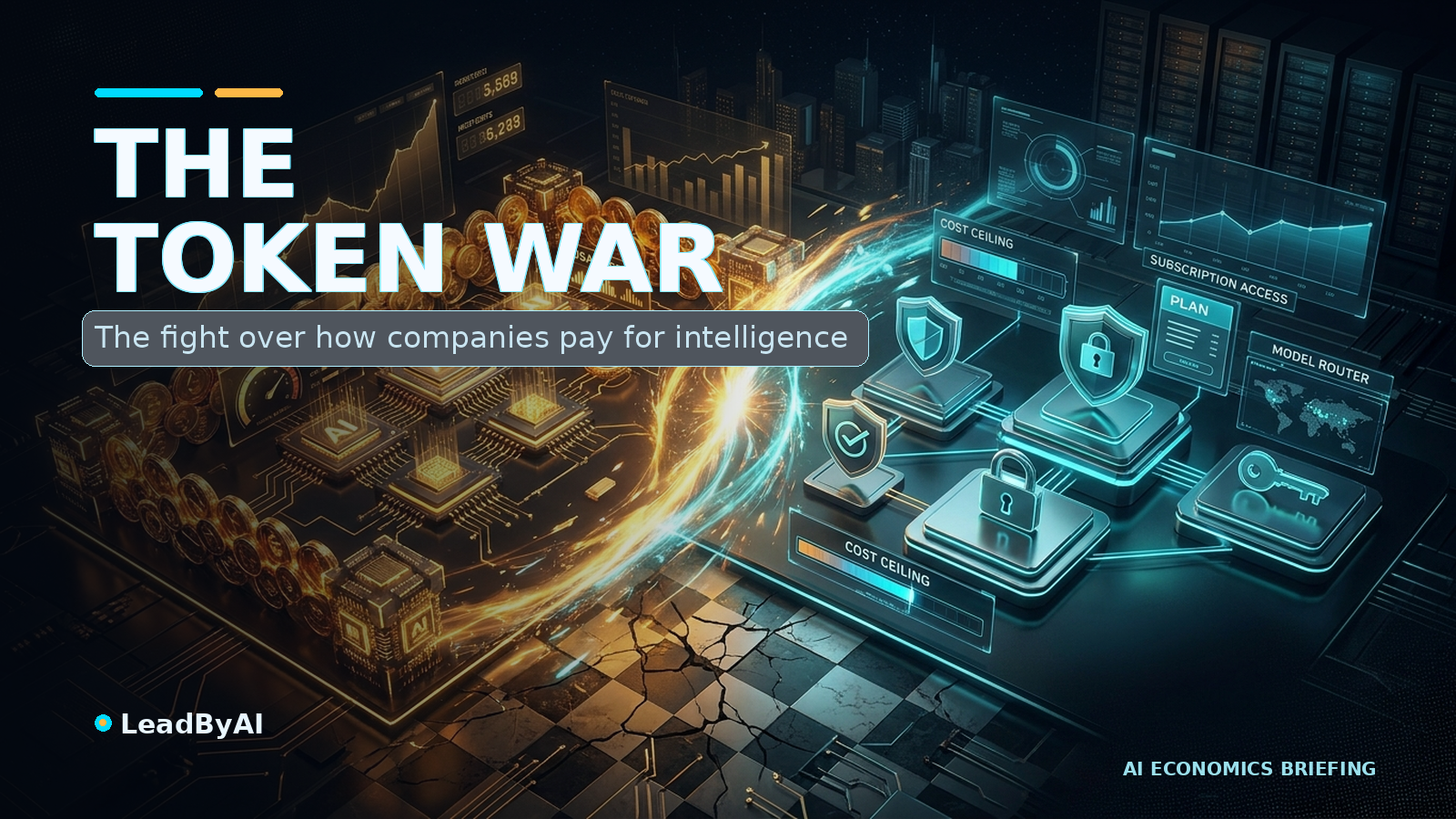
A fight is forming inside the AI market, and it is not really about which model wins the next benchmark.
It is about how companies are going to pay for intelligence.
On one side is the token economy: every prompt, every retrieved document, every reasoning trace, every tool result, every retry, and every output is metered in units that most executives cannot see, feel, or intuitively budget. On the other side is the subscription economy: access to very capable models through user seats, OAuth-connected tools, enterprise workspaces, and product plans that look more like SaaS than cloud infrastructure.
That divide is going to become one of the most important commercial battles in AI.
Call it the token war.
What is the token war?
The token war is the coming conflict between two pricing models for AI work:
- Token-metered AI — companies pay based on model usage, usually priced per million input and output tokens.
- Subscription-access AI — companies pay for access through a recurring plan, seat, or workspace, often with usage limits, rate limits, fair-use rules, or negotiated enterprise terms.
The tension is simple: agentic systems can consume enormous volumes of text. A single user asking a chatbot a few questions is not the expensive part. The expensive part is when a business starts letting AI agents read inboxes, inspect documents, summarize calls, browse CRMs, write follow-ups, run evaluations, retry failed workflows, and coordinate with other agents all day.
That is when tokens stop feeling like a technical detail and start behaving like an uncontrolled utility bill.
Tokens are real costs wrapped in an intangible unit
The core problem with token pricing is not that providers are wrong to charge for usage. Compute costs money. Frontier models are expensive to train, serve, secure, and scale.
The problem is that tokens are an abstract accounting unit. A token is not a page. It is not a minute. It is not a seat. It is not a task. It is not even exactly the same thing from provider to provider, because tokenizer behavior, cached-input rules, context handling, tool-call overhead, and output pricing all vary by model and platform.
That makes token cost hard to reason about in normal business language.
A CFO understands:
- 50 employees at a per-seat monthly rate
- 10,000 support tickets per month
- 2,000 hours of back-office processing
- a fixed software platform fee
- a contracted enterprise minimum
A CFO does not naturally understand why an agentic workflow cost less on Tuesday, more on Wednesday, and five times more on Friday because the model produced longer reasoning traces, retrieved larger documents, retried failed tool calls, or used a different context window.
That is why the token war is not only a pricing issue. It is a budgeting issue.
The API pricing gap is already visible
The public API market is still fundamentally token-metered. OpenAI’s current API documentation lists prices per one million tokens, including GPT-5.5 at 5.00 dollars per million input tokens and 30.00 dollars per million output tokens, with cached input priced separately. Anthropic’s Claude API pricing is also per million tokens: Claude Sonnet 4.6 is listed at 3 dollars per million input tokens and 15 dollars per million output tokens; Claude Opus 4.8 is listed at 5 dollars input and 25 dollars output; Claude Haiku 4.5 is listed at 1 dollar input and 5 dollars output. Google’s Gemini Developer API pricing likewise uses per-million-token tiers; Gemini 3.5 Flash is presented with a paid tier of 1.50 dollars input and 9.00 dollars output per million tokens.
Those numbers are not automatically unreasonable. For many applications, token pricing is efficient and fair. If usage is small, bursty, or tightly controlled, paying per unit can beat a subscription.
But agentic AI changes the shape of demand.
A lightweight chatbot might process thousands or millions of tokens. A serious operational agent network can process hundreds of millions or billions. Once AI becomes a workflow layer instead of a chat box, usage can grow faster than the organization expected.
For example, using public list prices as a rough illustration:
- 1 billion input tokens and 200 million output tokens on a model priced at 5 dollars input and 30 dollars output per million tokens is about 11,000 dollars.
- The same volume on a 3 dollar input / 15 dollar output model is about 6,000 dollars.
- At 10 times that workload, the monthly number moves into six-figure territory.
- At enterprise scale, with multiple agents, retries, evaluations, long-context documents, and tool overhead, the spend can become a board-level line item.
That is the pressure point.
Why subscriptions feel different
Subscription AI feels different because it maps to how businesses already buy software.
A subscription does not mean unlimited compute. Every provider still has capacity constraints, abuse controls, rate limits, and fair-use boundaries. But subscriptions package access in a way that is easier to approve, explain, and forecast.
Instead of asking, “How many output tokens will our finance workflow generate next quarter?” the business can ask:
- How many users need access?
- Which workflows require premium model capability?
- What usage tier or enterprise plan covers the expected load?
- What limits or overage terms apply?
- What is the monthly ceiling?
That is a very different conversation.
This is why OAuth-connected AI tools and subscription-based model access are becoming strategically important. If a company can run a meaningful portion of its knowledge work through authorized user accounts, enterprise workspaces, or subscription-access tools, it may prefer that model over a purely token-metered architecture — even if the token-based API offers more direct control, cleaner integration, or slightly stronger model performance.
The boardroom question will not be, “Which model is technically best?”
It will be, “Which pricing model lets us scale AI without creating a blank check?”
The hidden problem: agentic systems multiply tokens
Token spend does not grow linearly with “number of AI features.” It grows with the behavior of the system.
Agentic systems use tokens in places humans do not see:
- System prompts and policy instructions
- Retrieved documents and CRM records
- Tool schemas and function-call payloads
- Browser page text and DOM extracts
- Intermediate plans and reasoning outputs
- Verification passes
- Retry loops after failed actions
- Multi-agent handoffs
- Evaluation runs
- Logging, summarization, and memory updates
A business may think it is paying for “one AI response.” In reality, the workflow may involve ten model calls, three retrieval passes, two tool failures, a compliance check, a summarizer, and a second model acting as a verifier.
That architecture can be the right architecture. But it means token budgeting has to be treated like infrastructure engineering, not marketing spend.
Why token-only providers may be forced toward subscriptions
Token-only providers face a strategic risk: if their pricing feels uncapped, intangible, and difficult to govern, customers will look for alternatives.
They may not abandon frontier APIs completely. APIs are still necessary for deeply integrated products, custom applications, high-volume automation, fine-tuned workflows, and systems that need strict programmatic control. But many companies will split their AI stack:
- Use token APIs for production systems where precision, logging, integration, and governance matter.
- Use subscription-access models for human-in-the-loop work, research, drafting, analysis, and agent-assisted operations where the workflow can live inside a user-authorized environment.
- Use smaller or open-weight models for routine classification, extraction, preprocessing, and summarization.
- Reserve the most expensive frontier calls for the moments where quality actually changes the outcome.
That is the likely future: not one pricing model, but a blended model.
However, if a provider insists that all meaningful usage must remain token-metered, they may lose relevance in the mid-market and enterprise operations layer. Companies will not accept millions of dollars in variable token exposure if a sufficiently capable alternative can perform much of the work under a more predictable subscription structure.
The most commercially successful providers will probably meet the market in the middle: token APIs for developers, subscriptions for users, enterprise commitments for large organizations, and hybrid plans that put guardrails around runaway usage.
The “slightly less capable” model may win the workflow
In the token war, the best model does not always win.
The model with the best deployable economics often wins.
If Model A is 5% better but costs 10 times more at operational scale, many businesses will choose Model B. If Model A has a cleaner API but Model B can be accessed through a predictable subscription inside an approved workspace, Model B may own the workflow. If Model A is state of the art but creates unpredictable cost spikes, the business may reserve it for escalations while routing most work elsewhere.
That is especially true for agentic AI, because many business workflows do not require the absolute best model on every step.
A production agent might use:
- a lower-cost model to classify incoming work
- a mid-tier model to draft a response
- a stronger model to handle exceptions
- a human reviewer for high-risk outputs
- a frontier model only when the stakes justify it
The winning architecture is not “use the most powerful model everywhere.”
The winning architecture is “use the right intelligence at the right price for the right step.”
The governance issue: subscriptions are not a loophole
There is an important caution: subscription access is not a magic bypass for provider terms, data governance, or responsible usage.
Businesses still need to answer hard questions:
- Does the subscription plan permit the intended workflow?
- Are automated agents allowed under the provider’s terms?
- What data can be sent through the account?
- Are there retention, training, and privacy controls?
- Can activity be audited?
- What happens when the account hits a rate limit?
- Who owns the OAuth token and revokes access when employees leave?
- Can the workflow survive if the provider changes limits?
The token war should not push companies into sloppy architecture. It should push them into better procurement and better governance.
A subscription model may make spend more predictable, but it does not eliminate the need for policy, logging, security, and workflow design.
What companies should do now
The right response is not to pick a side blindly. It is to build an AI cost-control strategy before usage explodes.
1. Track cost per workflow, not just cost per model
Do not measure only total token spend. Measure cost by business process:
- cost per resolved support ticket
- cost per qualified lead
- cost per client review packet
- cost per compliance summary
- cost per invoice processed
- cost per sales follow-up sequence
Executives can make decisions when AI cost is tied to work output.
2. Route tasks by economic value
Not every step deserves the same model. Use cheaper models for routine work, reserve premium models for judgment-heavy steps, and evaluate whether subscription-access tools can handle human-in-the-loop tasks more economically.
3. Put ceilings on autonomous usage
Agent loops need budgets. Every workflow should have limits:
- max calls per task
- max retries
- max context size
- max daily spend
- escalation triggers
- logging requirements
If an agent cannot explain why it is still spending money, it should stop and ask for review.
4. Negotiate enterprise terms early
If token usage is becoming material, do not wait until the bill is painful. Providers may offer committed-use discounts, enterprise agreements, caching options, batch discounts, or custom terms. The earlier the procurement conversation starts, the more leverage the company has.
5. Design for portability
A company should avoid building every workflow so tightly around one provider’s pricing model that it cannot move. Good agent architecture separates the workflow, the model router, the memory layer, the tool layer, and the governance layer.
That makes it possible to shift work across token APIs, subscription-access environments, private models, and specialized providers as economics change.
What providers should understand
The providers that win the next phase of AI will not only have the best models. They will have the most believable commercial model.
Enterprise buyers want power, but they also want predictability. They want access to frontier intelligence, but they do not want surprise invoices. They want developers to build, but they also need finance teams to forecast. They want agents to work autonomously, but not with uncapped spend.
If token-only pricing becomes associated with runaway cost, the market will route around it.
That does not mean token pricing disappears. It means token pricing has to become more explainable, more governable, and more compatible with subscriptions, commitments, and outcome-based packaging.
The real winner of the token war
The token war will not be won by the provider that simply makes tokens cheaper.
It will be won by the provider — or integrator — that makes AI cost understandable.
Businesses do not want to buy tokens. They want to buy outcomes:
- faster operations
- fewer manual tasks
- better customer response
- safer compliance workflows
- more sales capacity
- stronger decision support
Tokens are just the metering layer underneath. If that metering layer becomes too abstract, too variable, or too risky, businesses will demand another model.
That is why subscription-based access is not a side issue. It is a strategic threat to token-only AI economics.
The next wave of AI adoption will be shaped as much by pricing architecture as by model architecture.
The companies that understand that first will build AI systems that scale without losing financial control.
The providers that understand it first will stay relevant when buyers stop asking, “How smart is the model?” and start asking, “Can we afford to let it work all day?”
LeadByAI perspective
At LeadByAI, we do not treat AI cost as an afterthought. We design agent systems around governance, routing, human oversight, and measurable business outcomes. The goal is not to use the most expensive model everywhere. The goal is to build an AI operating layer that is capable, controlled, and economically defensible.
If your organization is moving from AI experiments to real agentic workflows, the pricing model matters as much as the prompt.
Build for the token war now, before the bill makes the decision for you.
Ready to Put AI to Work?
LeadByAI specializes in OpenClaw implementation, Hermes Agent consulting, and supervised AI automation.
Get a Free Consultation →